These are my live notes from an organizational-behavior session on psychological capital, so they are mostly scaffolding: four labels, a definition, a diagram drawn at speed. This is the expanded version of the idea I marked with a heart in the margin.
Every organization I have worked in sorts people into those who have it and those who don’t. Resilient. Confident. A self-starter. Not a detail person. The sorting feels like plain observation — you are describing what you can see with your own eyes, over months, and you are usually describing it accurately.
Psychological capital is the argument that a good share of what you are seeing is not character. It is a training budget nobody spent.
There is a small green heart in the margin of my notebook next to the words POSITIVE PSYCHOLOGY. I do not draw hearts in notebooks.
The line that does the work
Before the four elements, the notes draw an axis, and the axis is the real content. Personality characteristics run from trait-like to state-like. Trait-like qualities hold steady across years. State-like qualities are, in my handwriting, “relatively changeable & a person can develop (or reduce) them.”
Psychological capital sits toward the state-like end. My note puts it precisely: more stable than a fleeting state of mind, but open to change — through self-awareness and through training.
That single placement decides everything an organization is permitted to do about it.
Trait-like
Stable across years. You measure it to predict a person.
The organizational lever is selection. If you want more of it, you hire for it.
State-like
Stable enough to measure, loose enough to move. You measure it to develop a person.
The organizational lever is training and managerial practice. If you want more of it, you build it.
I have spent about five years leading QA teams, and I have reached for the trait-like frame far more often than I would like to admit. It is a comfortable frame, because it relocates a problem out of my job and into someone’s character, where I am no longer the person responsible for it.
Four ordinary words doing precise work
The four elements are efficacy, optimism, hope and resiliency.
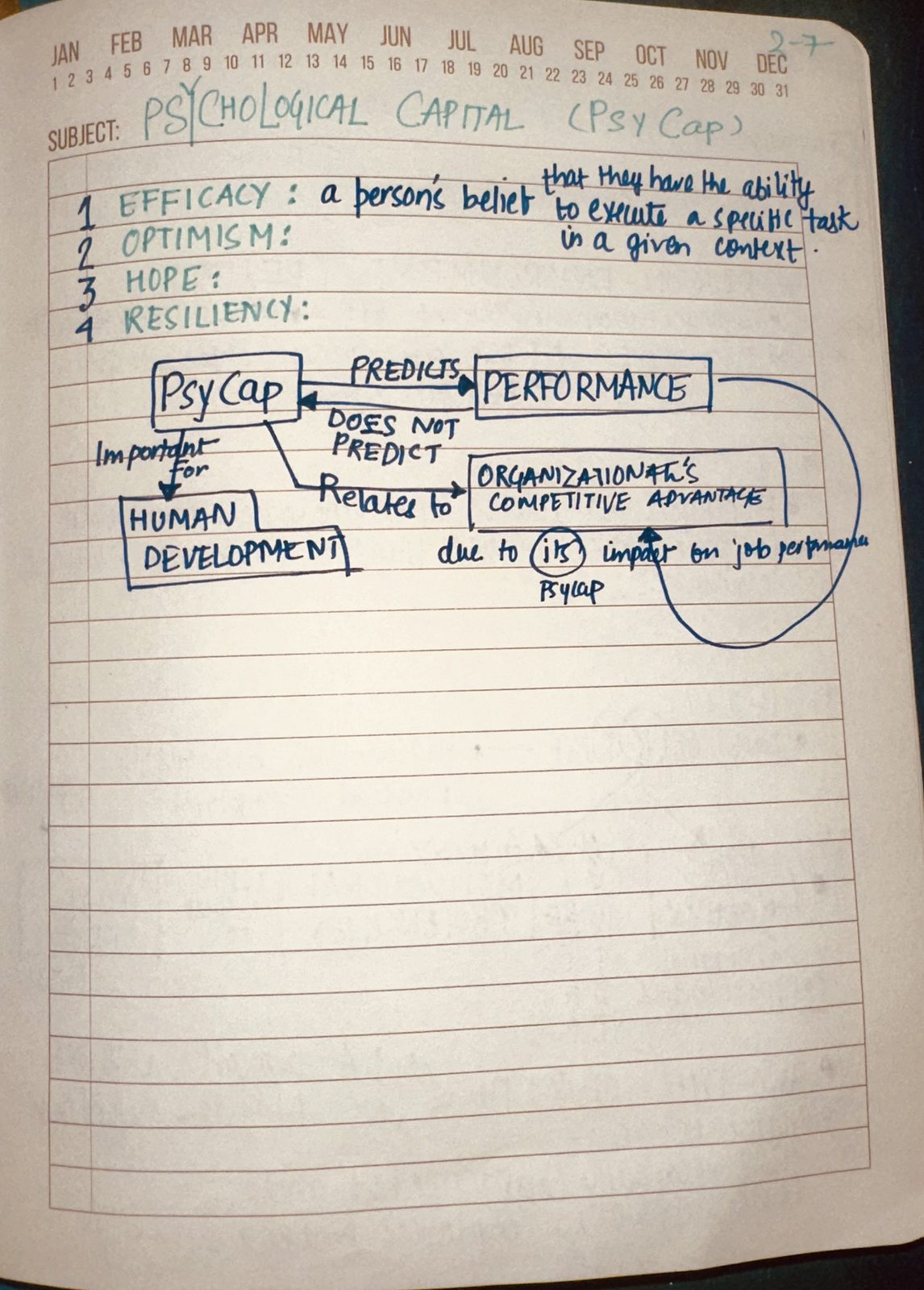
Three of the four are words everybody already owns, which is exactly the difficulty. The everyday meanings are close enough to pass for the technical ones and different enough to change what you do on Monday. In each case the everyday version describes a quality a person has, and the technical version describes a capacity somebody can act on.
Efficacy
Belief that you can execute a specific task in a given context. It is domain-bound: a person can be high on it in code review and low on it in a client call.
Heard as: confidence — a single dial for the whole person.
Hope
Goals, plus the will to pursue them, plus routes — and the habit of generating a second route when the first one closes.
Heard as: wishing. Passive, and slightly embarrassing to admit to at work.
Optimism
An explanatory habit: reading a setback as specific and temporary rather than as evidence about you, permanently, everywhere.
Heard as: expecting good news. A forecast rather than an explanation.
Resiliency
Recovering function after adversity — which depends as much on the assets around a person as on anything inside them.
Heard as: toughness. A quality of the individual, and their problem to have.
Hope is the one worth slowing down on. In the research tradition behind psychological capital it is not a feeling at all — it is a two-part capacity: the will to move toward a goal, and the ability to find another way when the way you planned is blocked. A person high on hope is not more cheerful than you. They have more routes. Which makes the practical test for hope not “how do you feel about this project” but “what is your second path, and when did you last need it.”
I have sat in status meetings where someone was written off as unrealistically optimistic when what they actually had was one route and a great deal of will. That is not high hope. That is half of it, and the missing half is the half a manager can supply.
The loop I drew as a line
On the facing page I drew four boxes and connected them.
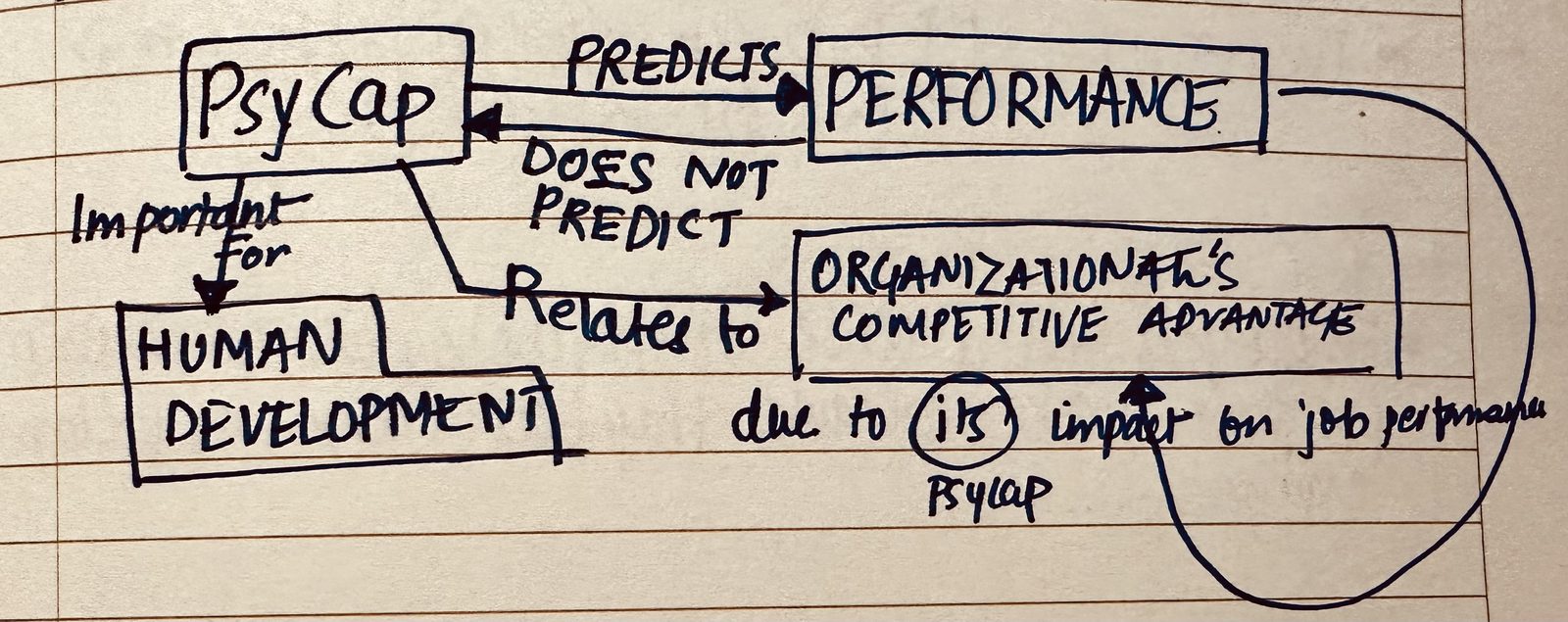
Two of those boxes carry two arrows between them, pointing in opposite directions. Mine says psychological capital predicts performance — and that performance does not predict psychological capital back.
The first half holds. The second half is the part I would redraw.
Bandura’s work on self-efficacy puts enactive mastery — actually doing the thing, and knowing you did it — at the top of the list of what builds efficacy in the first place. And the organizational research describes gain spirals rather than a one-way street: capacity raises performance, performance raises capacity, and the two climb together.
The loop is better for the argument than the line I drew, not worse. A one-way arrow gives a manager a lever they have to keep pulling. A loop gives them something that compounds: the first delivery a person genuinely owns pays out twice, once in the work and once in what it does to the next attempt.
What keeps that from being circular reasoning is that you can start the loop on purpose. Raise psychological capital deliberately — a short training, measured before and after — and performance moves afterward. That is the finding that makes this a management tool rather than a flattering description of people who were already winning.
It also means the loop runs down. A team that misses, loses conviction, and then misses again is not a morale problem that arrived from nowhere. It is the same mechanism in reverse, and it is worth remembering when somebody proposes to fix it with a workshop.
The rest of the diagram is the part that ends up in strategy decks: psychological capital relates to the organization’s competitive advantage, due to its effect on job performance. That direction of travel is fine. But the arrow I keep going back to is the short one running down the left side of the page — psychological capital is important for human development. The competitive advantage is a consequence of doing it. It is not the reason to do it.
What you actually change
Because the four elements have different definitions, they have different levers, and general encouragement moves none of them.
Efficacy
Hand over the smallest real version of the task, not the pep talk. Mastery on a narrow scope, then widen it. Let them watch a peer do it before they do it alone.
Hope
Ask for the second route before the first one fails. A pre-mortem is a hope intervention with a project-management name on it.
Optimism
Run the post-mortem on the explanation, not only the incident. "This build broke because the fixture was stale" and "this build broke because I am careless" are the same event and two different futures.
Resiliency
Inventory the assets, not the person. Slack in the schedule, a second person who knows the system, a manager who absorbs the first hit — that is resilience, held outside the individual.
Where I would push back on my own enthusiasm
A construct this attractive is easy to misuse, and the misuse has a predictable shape. An organization measures psychological capital, finds it low across a team, and concludes it has a mindset problem. Sometimes it does. Sometimes the same reading is simply correct — and optimism about a project that genuinely is doomed was never a strength.
One finding: hope scores are low across the team.
Read as a deficiency
The team needs a resilience workshop. The intervention is aimed at the people, and the finding becomes something they are doing wrong.
Read as accurate
There is one route, two people short, and a date nobody chose. Low hope is a correct measurement of that. The intervention is aimed at the route.
The second misuse is quieter: treating the state-like side of the line as though it had swallowed everything. It has not. Conscientiousness — the disposition toward order and follow-through that the Big Five measures — sits firmly on the trait-like side, and no amount of scaffolding turns a person into someone else on that axis. Psychological capital is a claim about four specific capacities. It is not a claim that character is editable on request, and the four are enough without that.
There is also a measurement question I cannot leave alone, because it is the one I bring to every self-report instrument: psychological capital is measured by asking people about themselves, at work, usually on a form with their employer’s name at the top. That does not make it worthless. It does mean a score is a conversation-starter and not a verdict — and that an organization using it to select candidates has quietly moved a state-like construct back onto the trait-like side of the page for its own convenience.
And there is a limit on me. A manager is not a clinician. The moment this turns into diagnosing someone’s motivation, or repairing something that predates the job, it has gone somewhere it does not belong and will not end well for either party. There is a structural ceiling too: no front-line manager out-scaffolds an unviable deadline set three levels above them, and pretending otherwise just relocates an executive problem onto a team lead. The people I work with are also adults who own their own drive — none of this makes me the author of anybody’s inner life.
What is left after those subtractions is still the larger part, because it is the part I actually control.
Why I am keeping this one
Most of what a course gives you is vocabulary for things you had already noticed. This gave me a line, and a decision about which side of it four things belong on.
The uncomfortable part is that the line runs in both directions. If these capacities are buildable, then the shorthand I have used for years to summarise a person stops being an observation and turns into an unstarted piece of work with my name on it.
"He takes every escaped defect as proof he is not good at this."
Nobody has walked him through the actual cause with him still in the room.
"She does not have the confidence for client-facing work."
She has never sat in one of those calls with someone she could watch first.
"That team gives up the moment something slips."
They have one plan, and no one has ever asked them for a second one out loud.
That is a heavier way to manage, though not in the way it first sounds. Nobody is asking me to repair anyone. The obligation is narrower than that and much harder to dodge: I am moving these four every week whether I attend to it or not — through the scope I hand out, the explanation I offer in a post-mortem, the slack I protect or spend. I do not have to fix anyone’s psychology. I have to stop managing in ways that quietly take it apart.
The choice was never whether to manage someone’s psychological capital. It was only whether to do it on purpose.
Comments